
The challenge of doing business in Russia
Russia is a vast market with geographic proximity to Nordic countries, but there are some significant differences in the Russian business culture. As exporters and vendors know, these differences cause some common challenges to foreign companies and managers.
Our idea of what is the right way of working and Western best practices originate from shared cultural values. Since we tend to work on autopilot a lot, we also fall back on the business culture and practices we know best.
This is important to notice because the differences can affect your business’s success in a concrete way.
Maybe you naturally seek to maximize annual sales and the bottom line, for example. Your Russian partner, on the other hand, can put more emphasis on the market share development.
You might be used to building a sales pitch on the emotional aspects and keeping it concise. But a Russian manager usually expects to hear a detailed and factual presentation.
All of us working with Russia are familiar with many of the challenges in this market:
- the weakened ruble making already expensive products more expensive
- political challenges impacting business
- excessive bureaucracy
- complex foreign trade regulations
- changing requirements
To negotiate and interact with partners and end customers, companies usually need interpreters. For the companies that don’t hire professionals, this can cause many misunderstandings between partners.
Russia is not the easiest market to work with. So it doesn’t come as a surprise that most Nordic exporters prefer working with Russian channel partners. It means they can outsource many of these problems.
In this blog post, we’ll present the challenges of doing business in the Russian business culture from a new angle -one which has provided exporters with a distinct advantage in the market – and talk about how companies can take advantage of the deep understanding of their own background to build profitable and lasting partnerships that lead to effective strategic solutions and greater business success in Russia.
What kind of business relationships between vendors and sales partners bring results in Russia?
These are the two main questions that Nordic companies should pay attention to in Russian speaking countries when they work through partners:
- What are the roles and expectations of all parties in the channel?
- How do we adapt to the unpredictable and complex situations that often come up in Russia?
Given that it is easier to work with a local partner to outsource some of the regulatory and requirement issues, companies must pay close attention to understanding the roles of all parties involved.
It may sound obvious but you have to make a real distinction in your mind between your partner who is importing, selling, distributing, or otherwise supporting your product and customers who are the end-users of the product or service.
Getting this right plays a key role for vendors, who face growing pressure to deliver better outcomes to customers.
Understanding the needs of your partners can have a crucial impact on the end results
Your partners are under pressure to deliver better results for end customers. It forces them to shift their focus from a transactional business model and provide more customer-centric solutions with your product, but they are naturally reluctant to carry the burden alone and compromise their margins.
The attractive approach for your partners is that you actively join in the marketing, sales, and customer care efforts, drive initiatives and develop the market together.
Developing this kind of close cooperation is of great help for exporters in Russia. But it requires a second element, which is also the best predictor of international trade success.
While Russia is geographically close, it is culturally distant from the Nordics. When working with Russian partners you need to first understand the rules of the game and build a culturally intelligent approach to boost your business.
The power of cultural intelligence lies in adapting to the business culture and aligning your existing strategies with information about the common values in Russia.
Understanding the factors that govern business relationships, decision making, and business planning, in general, can help you detect tendencies, how Russian companies and the key people you work with think, behave and accept your thinking and behavior.
We offer online training on Russian Business Excellence to companies and professionals who want to excel in Russian business culture. Contact our CEO at pia.kahara@incultures.com to find out more.
Strategic reasons for taking a culturally intelligent approach (customer case)
Many studies have shown that cultural intelligence is a stronger predictor of cross-border leadership effectiveness than both general and emotional intelligence alone. In practice, we’ve seen that it also has real business implications.
In 2015, our customer, Jokasafe Oy, struggled with the same problems most Nordic vendors face in Russia:
- drastically weakening ruble
- end-customers with fixed budgets choose cheaper competing products
- distributor’s pressure for price reductions
Their sales dropped by 30% in a very short time.
Cutting down on market development costs and waiting for a better time would have been one option, but it would have compromised the whole export business. In Russia, personal level relationships with business partners are crucial. When you strengthen cooperation with partners in difficult circumstances, your loyalty is valued and it helps form true partnerships.
If your only solution is to cut your costs and leave the problems for the other side to handle, you will not have a motivated partner to do business with, when the market situation improves.
“Pia’s insight and advice in both strategic and operative issues have helped us overcome many difficult situations in our export markets in Russia and Russian speaking countries during the years.”
Karoliina Sulkakoski, CEO of Jokasafe
This is to say that by implementing a culturally intelligent strategy of investing more time in developing the market in close cooperation with the local partner instead of cutting down on market investment, Jokasafe made a culturally intelligent strategic choice.
They had more personal meetings and frequent and open cards communication between partners, which in turn led to a flexible attitude from both partners for temporary price and margin reductions to secure customers and market share.
The joint actions taken to support all channel levels led to remarkable results in the difficult market situation. Jokasafe returned its business results to the previous level surprisingly quickly and increased sales in the longer term even though the market growth figures have so far not returned to the same level as before 2015.
The successful outcome was based on long-term personal relationships and trust. In the Russian business culture, good partnerships are not possible without them.
If Jokasafe had simply cut back and waited for better times as might be appropriate in the Nordic business culture, they might be out of business in Russia.
Instead, cultural intelligence helped them deal more efficiently with a difficult situation. They made it an advantage when many others were panicking.
There are a lot of business situations where you have to make culturally intelligent adaptations. They have to do with Russian business etiquette, meetings and negotiations, approach to contracts, leadership behavior, business planning, and bureaucracy. All of them have key differences to how you might do things in the Nordic countries.
Why is Russian culture so different?
Imagine sitting down with a group of people from the Nordics, Baltics, and the Netherlands to discuss a business solution. For a Nordic exporter, this is a low-stress situation where everyone shares a very similar background and set of values. There is little need to stop and wonder why people think and behave the way they do.
Individuals’ behaviour will always differ. But these cultures belong to a group called the ‘Network Cluster’ with a similar mindset based on key value-based characteristics.
It means there are few value level differences between your country and the other participants. The feeling of familiarity makes you instinctively trust each other easier.
Simply put, the Russian culture looks very different. Someone from the Network Cluster background needs to take this into consideration to make good strategic decisions. In effect, we should always look at our background and assumptions first and then compare them to Russia.
Someone from India or the US might not view aspects of Russian business culture the same way or encounter similar challenges. Their challenges originate from their background.
Check out our article on the 6 questions Nordic exporters need to ask to be successful in Russian-speaking countries to learn more about the differences.
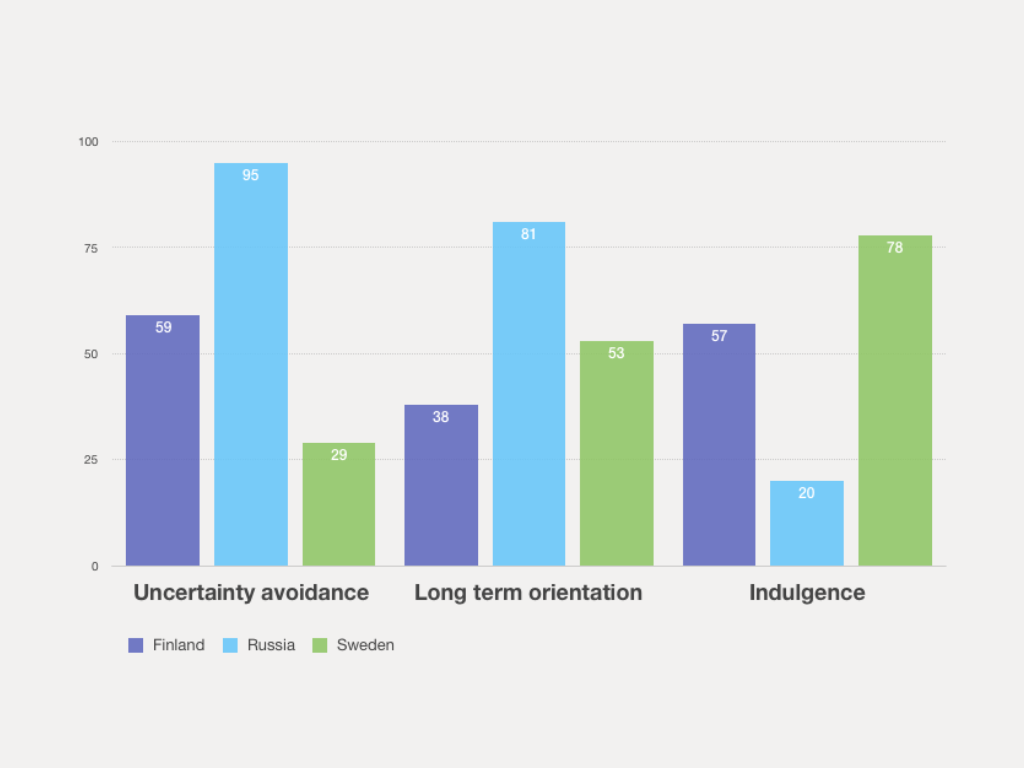
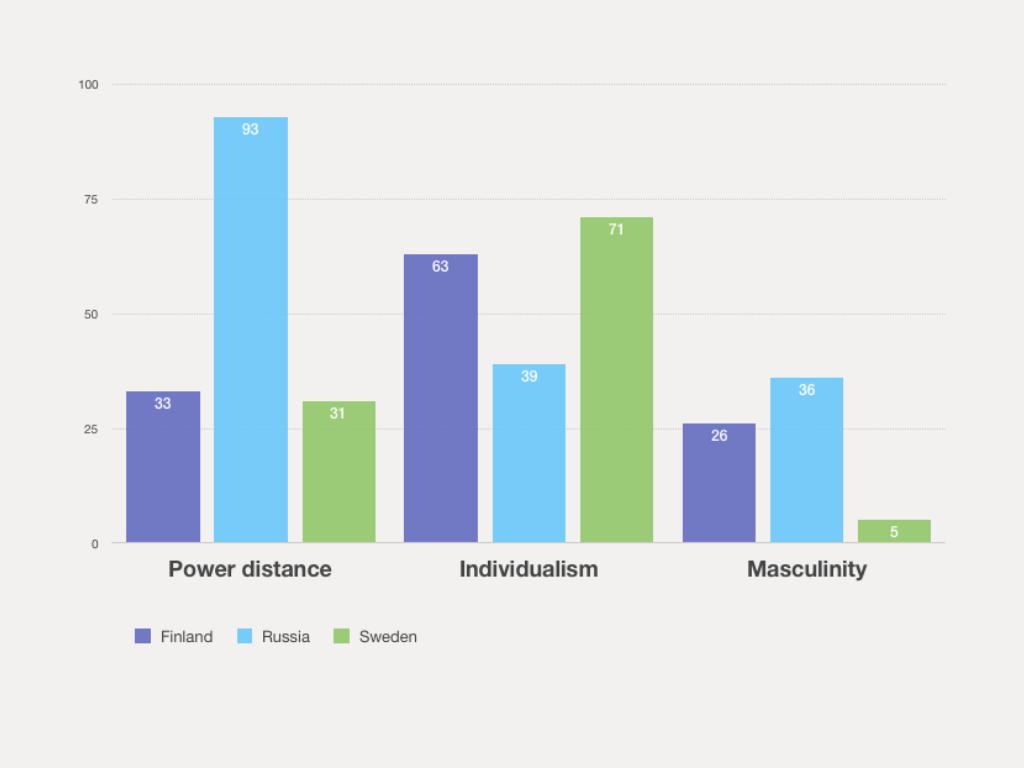
Cultural differences that affect working with Russian culture can be depicted by looking at different value-based characteristics. Source: Hofstede Insights.
How to develop cultural intelligence in the context of Russian business culture
Developing your cultural intelligence as a manager in the context of Russian business culture has three main objectives:
- Being aware of biases (your idea of good and bad) and the need to be culturally sensitive, but going even beyond that to adapt to diverse thinking and behaviour.
- Understanding the value based cultural differences between your own background and Russia
- Focusing on developing your skillset to meet the challenges posed by the variety of Russian contexts you will encounter.
Unfortunately, the existence of these different contexts means that managers who are effective and successful in their own country or within cultural clusters that are very similar to their own may not be effective elsewhere without actively developing these new skills.
In contrast, once you build cultural intelligence, you can start understanding the implications culture has on the situations you face. You’ll build strategies and a skillset for effectively overcoming these differences or even making them your competitive advantage. In many cases, it is possible to adapt to differences in the environment in a much more dynamic and intelligent way.
The question of how you can quickly adapt with cultural intelligence is often a tricky one. There is no single solution that is suitable for all businesses and all situations.
Your solutions depend on your goals and strategy and must be adapted for your company’s specific needs and characteristics. This is why it is crucial to have on the same team experts from your business who understand the specificities of your own market and export business, and experts who understand cultural differences and possess cultural competence in your export market.
It doesn’t matter whether you work on the strategy and solutions in-house with training on cultural intelligence or hire consultants. The key is to have these people working side-by-side.
Get our latest articles and tools for developing cultural competence and cultural intelligence. Subscribe to our newsletter.
3 examples of key differences and how to adapt to build a better partnership with a Russian company
In the Russian market, the conditions dictate that you need quick, creative thinking and the ability to create flexible solutions if you want to be successful.
It might, then, not come as a surprise that Russian partners generally build trusted partnerships and have their eyes set on long-term business success. They want to solve problems together.
To become a trusted business partner for the long term, you need to adapt to your Russian partner’s expectations and invest time in building personal relationships.
Here we give you examples of some key differences between the two cultural clusters. They will help you take actions that align with your strategy and the local business culture.
1. Create personal relationships with several contacts within the partner company and build a network
First of all, it is crucial to understand that business partnerships in Russia are really built between people, not between companies.
If you only know one person in your partner company and that person leaves without introducing you as a trusted person to the successor, you will have to build the personal trust and relationship with the new decision-maker from scratch.
This is why you must invest time and effort in building relationships and trust with several key stakeholders in your partner company as possible. And have a backup plan in case your key contacts leave.
In a collectivistic country like Russia, many doors also open through introductions and recommendations by trusted contacts within different networks.
If you do not have these relationships, you will have to go through “gatekeepers” and write official letters that preferably contain your company’s round seal. You will likely have to make numerous calls afterwards to talk to the right person at the decision-maker level.
In general, due to the high uncertainty avoidance of Russia, expect more formality and behave more formally at the beginning and less as you have broken the ice and built a closer relationship. Levelling the formality up from the Nordic level helps you to navigate the business etiquette in Russia.
2. Know the decision-making process
Unlike the Nordic countries, Russia is hierarchical, and you have to respect the hierarchy to get anywhere. You will encounter top-down decision-making when you cooperate with your partners. It is important to identify the key decision makers.
People in Russian organizations work on clear and limited mandates. They are not supposed to trespass. It would help if you considered that anyone you talk to might have to ask their superior for permission for most decisions. It is important to know the partner company’s decision-making process and who makes decisions about what.
You might have seen high uncertainty avoidance in the Russian bureaucracy your company meets, but it also affects many other practices of companies.
Your counterparts usually investigate things and people thoroughly from different sources, reflect and plan carefully before they act. They want to see good structure in your ideas and proposals, too.
Emotional sales pitching does not convince Russians. They rather want all the details, and double-check all information.
3. Prepare strategically for meetings and negotiations
Once you have secured a meeting or are taking part in negotiations with a Russian company, it is necessary to apply the knowledge from the previous two steps.
The Russian decision-makers expect to speak only to other decision-makers at the same level. If the meeting is important, send your top management to ensure that their Russian counterparts will be there.
Meetings are leader-centric, so asking questions from anyone other than the person leading might embarrass both the leader and team member. There is a clear mandate for who can speak on behalf of the Russian company.
That is why many participants from your partner organization do not take part in the discussion in the meeting unless their superior asks them to. They also won’t question anything their superior says.
Russians usually organize meetings on relatively short notice from the Nordic perspective. Something always comes up in the fast-paced environment or from higher up in the hierarchy, so plans are kept flexible.
When you organise a meeting, two or three weeks’ notice is usually fine for a foreigner. It is a good idea to confirm multiple times that you are coming. If you set up a meeting a month ago and you fail to remind them a week beforehand, you can be almost certain they are not expecting you on the day. In fact, most Russians make a call when they are on their way to confirm they are coming to a meeting.
As a vendor, concentrate on building a relationship and trust first instead of giving a pure sales pitch.
Create a pleasant atmosphere with small talk first. In addition to your ordinary presentation detailing your company’s value as a possible vendor partner and your product or service, be prepared to answer very detailed technical questions.
“I don’t know” is not as widely accepted as an answer in Russia as it is in the Nordics. Thorough preparation or a direct line to the main office to the right people who know the detailed answer is the key to credibility.
The right kind of partner is the first step for export success in Russia
Companies often want to skip the market analysis stage to save time and money and eventually do business with the wrong partners and useuse the wrong competitive strategy. You need to position your offer right, and the partner must be able to serve the chosen target group.
It is important to ensure that the partner can handle Russia’s complex logistical systems and import procedures and is experienced enough to understand what European partners usually require from their business partners. It is also essential in a collectivistic country that the partner has a good network and relationship in the field.
Russia is not very transparent, so it is not easy to get information from open sources. That is why many Nordic vendors have made the mistake of skipping the due diligence and being overly trusting.
It is very important to perform a background check of your potential partner to understand their status:
- ownership
- financial situation
- reputation
- possible issues with tax or other authorities
If you have skipped this step so far, complete it now. It is the first step to take before you focus on other aspects of building the partnership.
Most companies outsource the task to service providers (like our parent company Sarus), but it is possible to do it yourself, too.
Take part in our Russian business excellence training online. Learn how to do a background check in our one on one calls. Apply now by e-mailing pia.kahara@incultures.com .
Final thoughts on Russian business culture
Cultural intelligence and cultural competence are soft skills that have become extraordinary tools to integrate into any international vendor’s toolkit. They allow vendors to put their strategic plans into action and align their action steps with the local culture.
The “learning by doing” approach without a deeper cultural knowledge base will not provide you with results in a reasonable time frame. Neither does studying only surface-level cultural differences like ‘how to dress to business meetings’ or ‘how to greet’ in a given culture.
So, the key value of a culturally intelligent approach to Russian business culture does not lay in understanding language, local customs and etiquette alone.
It lies in predicting better complex situations that come up in this business environment and learning which actions are the best to take to reach the strategic goals of the export business. Therefore, cultural intelligence requires an open mindset, flexibility, knowledge of cultural differences, and the ability to adapt your behaviour.
To sum up, cultural intelligence in the context of Russia allows you to:
- Understand how your own cultural background affects your thinking and actions and how your partners and customers will perceive your actions and strategies.
- React to different situations in this export market in an appropriate way. That helps you grow and maintain your export sales even during difficult times.
- Build trust and better partnerships through real win-win cooperation, where both sides have a clear role in developing the market together, and both sides are open to measuring success through shared systems.
- Find the best strategies that align with the characteristics of Russian business culture for negotiations, meetings, and implementing contracts.
And finally, to learn how to best support the Russian sales channel in achieving the best results in selling your products and services. This, in turn, allows them to deliver competitive solutions for end customers.
What next?
At InCultures, we are experts on building cultural competence. We have over 25 years of experience working as managers and business consultants in the Russian market with a local team and are happy to partner with your export manager or team to help you build cultural intelligence into your export strategies and develop your sales and distribution channel support.
By working together, we can help your company understand Russian business culture and take leaps in applying what you learn as actionable steps in your export business. Like we have helped over 200 Nordic SMEs over the past 10 years.
Our working scientific models, analysis tools, and sales channel training programs will save you from years of trial and error.
If you have any doubts or ideas just contact us. We are here to help you.